 Discovery Hub
Guide
Defensible disposition: deleting data you no longer need to keep
When a matter closes, the data collected for it doesn't need to stay forever. Defensible disposition is how you delete it in a way you can explain and prove later.
What defensible disposition means
Defensible disposition is the practice of deleting information once there is no longer a legal, regulatory or business reason to keep it, following a consistent process and keeping a record of each decision. "Defensible" is the important part: if a court, regulator or opposing party later asks why something was deleted, you can show that it was deleted on purpose, under a policy, after the right checks, by people with the authority to approve it.
For legal and eDiscovery teams, this usually means the collections gathered for litigation and investigations: mailbox exports, file shares, device images, chat exports and similar data copied for a legal hold.
Why it matters
Keeping everything can feel like the safe choice. In practice, data kept past its purpose carries real costs and risks:
- It stays discoverable. Anything you still hold can be requested in the next matter, and has to be searched, reviewed and possibly produced.
- It costs money. Storage, backups and review time grow with every collection you keep.
- It adds privacy and security exposure. Collections often contain personal and confidential information. Privacy laws generally expect personal data not to be kept longer than needed, and old data is still data that can be breached.
Deleting carelessly carries its own risk. Destroying information that should have been preserved for a pending or reasonably anticipated matter can lead to court sanctions for spoliation. That is why the process matters as much as the deletion.
When data becomes eligible for disposition
Releasing a legal hold doesn't on its own make the data safe to delete. Before a collection is disposed of, confirm that:
- No active legal hold still covers it. The same custodian or data is often subject to several matters at once. A collection made for one matter may still be needed for another.
- No litigation is reasonably anticipated that would need it, even if no hold has been issued yet.
- Retention requirements have been met. Your records retention schedule, and any regulatory retention rules that apply, set minimum periods that a hold release doesn't override.
- The business no longer needs it. The people who own the data agree it has no ongoing use.
What a defensible process looks like
Courts and regulators generally look for reasonableness and consistency rather than perfection. A process that holds up usually has these parts:
- A written policy. Who can flag data for disposition, what checks are required, who approves, and what is recorded. Apply it the same way every time.
- A check against every active hold. Check right before deletion, not just when the hold was released. Data can go back on hold between the decision and the deletion.
- Approval by the right people. Legal, records management and data owners each get a say before anything is deleted, with a clear way to object.
- Objections that are resolved, not lost. If someone asks to keep data, it waits until someone with authority decides, and the reason is recorded.
- A record of what was deleted. What was deleted, when, why, and who authorized it. Keep the record long after the data itself is gone.
- Confirmation that it's actually gone. Verify the deletion happened rather than assuming the job worked.
Common mistakes
- Deleting as soon as a hold is released without checking whether other holds or retention rules still apply.
- Approvals buried in email threads that nobody can find when the decision is questioned years later.
- No record of what was deleted, only a note that "the cleanup was done".
- One-off cleanup projects instead of a repeatable process, so each round is handled differently.
- Losing track of where collections live, so some copies are deleted and others are forgotten.
How Discovery Hub supports defensible disposition
Discovery Hub keeps legal holds, custodians and collections in one record, so disposition decisions can be checked against everything else that is going on.
- Reports for closing a matter. When a hold is released, a report lists the data collected for it that is no longer on any hold, ready for disposition.
- Approval before deletion. When you require it, collections flagged for deletion go to your Disposition Approvers first, and nothing is deleted until every one of them has approved it.
- Objections are resolved, not lost. An objected collection waits until someone with authority keeps it or disposes of it, with a note.
- Never while on hold. Data that has gone back on a legal hold is taken out of the run before anything is deleted.
- Disposition certificates. Each run records what was deleted, who authorized it and why, and every file in it, with a fingerprint that shows if the record is changed afterwards.
- Confirmed gone. A collection is marked deleted only once its folder is confirmed to be gone.
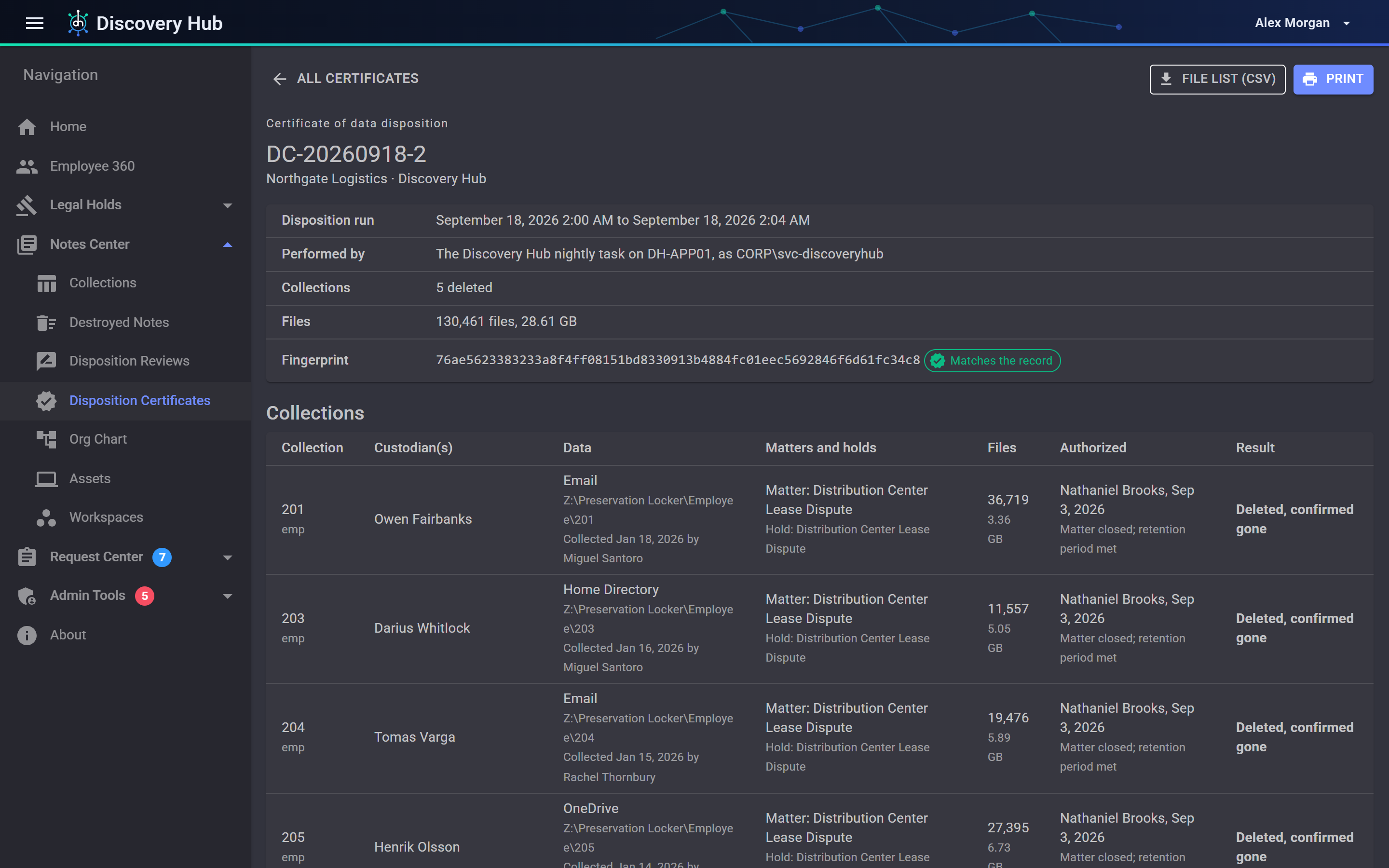 (opens the full-size image)
This guide is general information, not legal advice. Work with your counsel to set retention and disposition policies that fit your organization and jurisdictions.